

Share on Mobile
Scan to access on mobile
Keywords
INTRODUCTION
Table 1: Different identification techniques for nanoemulsions.
|
Characterization Technique’s |
Description |
|---|---|
|
Encapsulation Efficiency |
Drug content is estimated by spectrophotometric analysis of the extract at the λ of the drug after max making appropriate dilutions against appropriate blanks. |
|
Particle size and Polydispersity Index (PDI) measurements |
Particle size and PDI of nanoemulsions are analysed using Photon Correlation Spectroscopy (PCS) using a Malvern Zetasizer to monitor changes in light scattering due to Brownian motion of particles as a function of time (Baboota et al., 2007). |
|
Determination of Zeta Potential |
To calculate the zeta potential, the nanoemulsion was diluted and its value is calculated from the electrophoretic mobility of the oil droplets. A zeta potential of ±30 mV is probably sufficient to ensure the physical stability of the Nanoemulsion (Đorđević et al., 2015). |
|
Fourier-Transform Infrared Spectroscopy (FTIR) |
FTIR can be performed to find drug excipient interactions, polymerization, crosslinking, and drug loading in a formulation. It is also used to identify functional groups through their attachment and molecular fingerprinting (Srilatha et al., 2013). |
|
Morphological study of nanoemulsion |
The study of Nanoemulsion for its morphological properties is performed by the use of a Transmission Electron Microscope (TEM). To perform TEM, a few drops of nanoemulsion or suspension of lyophilized nanoparticles in double distilled water are prepared and placed on a perforated membrane grid and immobilized (Bali et al., 2010). |
|
Atomic Force Microscope (AFM) |
AFM is performed by diluting the nanoemulsion with water and then drop coating the diluted nanoemulsion onto a glass slide (Karthikeyan et al., 2012; Drais and Hussein, 2015) |
|
Dispersibility studies |
Dispersibility studies to evaluate the efficiency of self-emulsification of nanoemulsions are performed using standard USP XXII dissolution equipment (Kotta et al., 2014) |
|
Viscosity measurement |
Viscosity evaluation is an important parameter for the physicochemical characterization of nanoemulsions. A variety of instruments are used to measure viscosity, including Ostwald viscometers, Hepler falling ball viscometers, Stormer viscometers, Brookfield viscometers (Kuo et al., 2008; Harwansh et al., 2011; Malik et al., 2014) |
|
Refractive index |
The refractive index (n) of a medium can be defined as the ratio of the wave velocity (c) in the reference medium to the wave phase velocity (vp) in the medium (Harika et al., 2015; Gué et al., 2016). |
|
Measurement of pH and osmolarity |
The pH meter is utilized to degree the pH of a nanoemulsion and to decide the osmolarity of an emulsion with a smaller scale osmometer utilizing the solidifying point strategy (Morsi et al., 2014) |
Table 2: Recent advancements in delivery of nanoemulsion drug.
|
Routes of administration |
Methods/Materials |
Treatment |
References |
|---|---|---|---|
|
Occular drug delivery Tamoxifen |
Water titration technique (oleic acid, tween 80 or tween 20 and PEG400). |
Photoreceptor degeneration disorder. |
(Aboumanei and Mahmoud, 2022) |
|
Isoliquiritigenin (ISL) |
Pseudo ternary phase diagrams (PEG400, Propylene Glycol Dicaprylate (PGD), Cremophor EL). |
Treatment of Corneal Neovascularization (CNV). |
(Zhang et al., 2022) |
|
Celecoxib |
Pseudo ternary phase diagrams by titration method (Tween 80, propylene glycol, oleic acid). |
Rheumatoid arthritis and osteoarthritis, analgesic. |
(Salimi and Moghimipour, 2017) |
|
Brinzolamide |
Spontaneous emulsification method (Triacetin, labrasol, cremophore, capryol90). |
Occular hypertension |
(Mahboobian et al., 2017) |
|
Situ Occular gel of diclofenac sodium |
Pseudo ternary phase diagram (Oleic acid, Tween 20, Ethanol, poloxamer 407). |
Improving corneal penetration |
(Chauhan and Batra, 2018) |
|
Oral drug delivery Letrozole |
Simple titration method (Oleic acid, tween 80, olive oil, sesame oil). |
Breast cancer. |
(Alhamdany et al., 2021) |
|
Fenofibrate |
Pseudo ternary phase diagram by hydrophilic titration method (Tween80, PEG400, methanol). |
Hypolipidemic agent |
(Gulati et al., 2021) |
|
Felodipine |
Pseudo ternary phase diagram by hydrophilic titration method (Tween 80, tween 60, ethanol). |
Blood pressure and angina pectoris. |
(Hamed and Abd Alhammid, 2021) |
|
Montelukast sodium |
Ultra-sonication method (Tween 20, tween 40, tween 60, tween 80, propylene glycol, PEG400, Oleic acid, clove oil). |
Asthma and seasonal allergies. |
(Almajidi and Mahdi, 2018) |
|
Exenatide (Peptide) |
Hydrophilic titration method (Tween 80, capric acid, span 80) |
Antidiabetic |
(Lin et al., 2019) |
|
Carvedilol |
Hydrophilic phase titration method (Tween 20, PEG 200, PEG 400, PEG 600, Castor oil, span 60). |
Congestive heart failure and hypertension. |
(Chidi et al., 2017) |
|
Intravenous drug delivery 4-(chloromethyl)-3-nitro-N- (2-hydroxyethyl) benzamide (CNB) |
Hot melting homogenization method (Tween 80, glycerol, sesame oil, soybean lecithin). |
Cancer |
(Duarte et al., 2019) |
|
Rifampicin |
Hydrophilic phase titration method (Tween 80, tween 85, sefsol 218). |
Antitubercular |
(Ahmed et al., 2008) |
|
Nimodipine |
Simple hydrophilic solubility method (Methanol, heparin sodium salt, diethyl ether, acetonitrile). |
Ischemic cerebrovascular and Alzheimer’s disease. |
(Huang et al., 2020) |
|
Carvedilol |
Ultrasonication method (Tween 80, oleic acid, PEG 400, methanol, NaOH). |
Antihypertensive |
(Kumar et al., 2018) |
|
Intranasal drug delivery Tetrabenazine |
Pseudo ternary phase diagrams using hydrophilic titration method (Tween 20, tween 80, labrasol, transcutol, acetonitrile). |
Huntington’s disease |
(Arora et al., 2020) |
|
Sumatriptan (SMT) |
Hydrophilic phase titration method (Tween 20, tween 80, copaiba oil, pectin). |
Migraine |
(Ribeiro et al., 2020) |
|
Vitamin E loaded Naringenin |
Hydrophilic titration method (Caproyl 90, PEG 400, Tween 80, captex 200, olive oil). |
Parkinson’s disease |
(Gaba et al., 2019) |
|
Almotriptan |
Titration method (Oleic acid, tween 20, carbitol, polyethylene sorbitan monolaurate). |
Headache, nausea |
(Wagh and Mane, 2022) |
|
Zolmitriptan |
Ultra-sonication method which is high energy method (Caproyl PGMC, Captex 200, Polyoxyl 40, castor oil). |
Migraine |
(Abdou et al., 2017) |
|
Rizatriptan benzoate |
Pseudo ternary phase diagram (Oleic acid, Tween 20, sesame oil, tween 80, olive oil). |
Migraine, headache |
(Hadi and Ghareeb, n.d.) |
|
Topical drug delivery 8-methoxypsoralen |
High pressure homogenization method (Cremophor RH 40, PEG 40, hydrogenated castor oil, chitosan). |
Skin disease such as vitiligo and psoriasis. |
(Barradas et al., 2018) |
|
Daidzein |
High pressure homogenization technique (ethyl oleate, Tween 80, dimethyl sulfoxide, sodium dodecyl sulfate, isopropyl alcohol, methanol). |
Antioxidant and anti-inflammatory exercises and hinder development of cancer cells. |
(Kaplan et al., 2019) |
|
Econazole nitrate |
Spontaneous emulsification method (Oleic acid, PEG 200, Tween 20). |
Skin and fungal disease. |
(Shaikh et al., 2019) |
|
Febuxostat |
High speed homogenization technique (isopropyl myristate, span 80, Tween 80). |
Hyperuricemia, Gout |
(Reddy and Sundari, 2019) |
|
Flucinolone-acetonide |
Pseudo ternary phase diagram by hydrophilic dilution method, ultra-sonication method (Oleic acid, Tween 20, PEG 400). |
Reduce inflammation of skin |
(Katyan et al., 2022) |
|
Rifampicin |
Sonication method (Benzoic acid, oleic acid, Tween 80, salicylic acid). |
Bacterial and fungal infections of skin |
(Begum et al., 2019) |
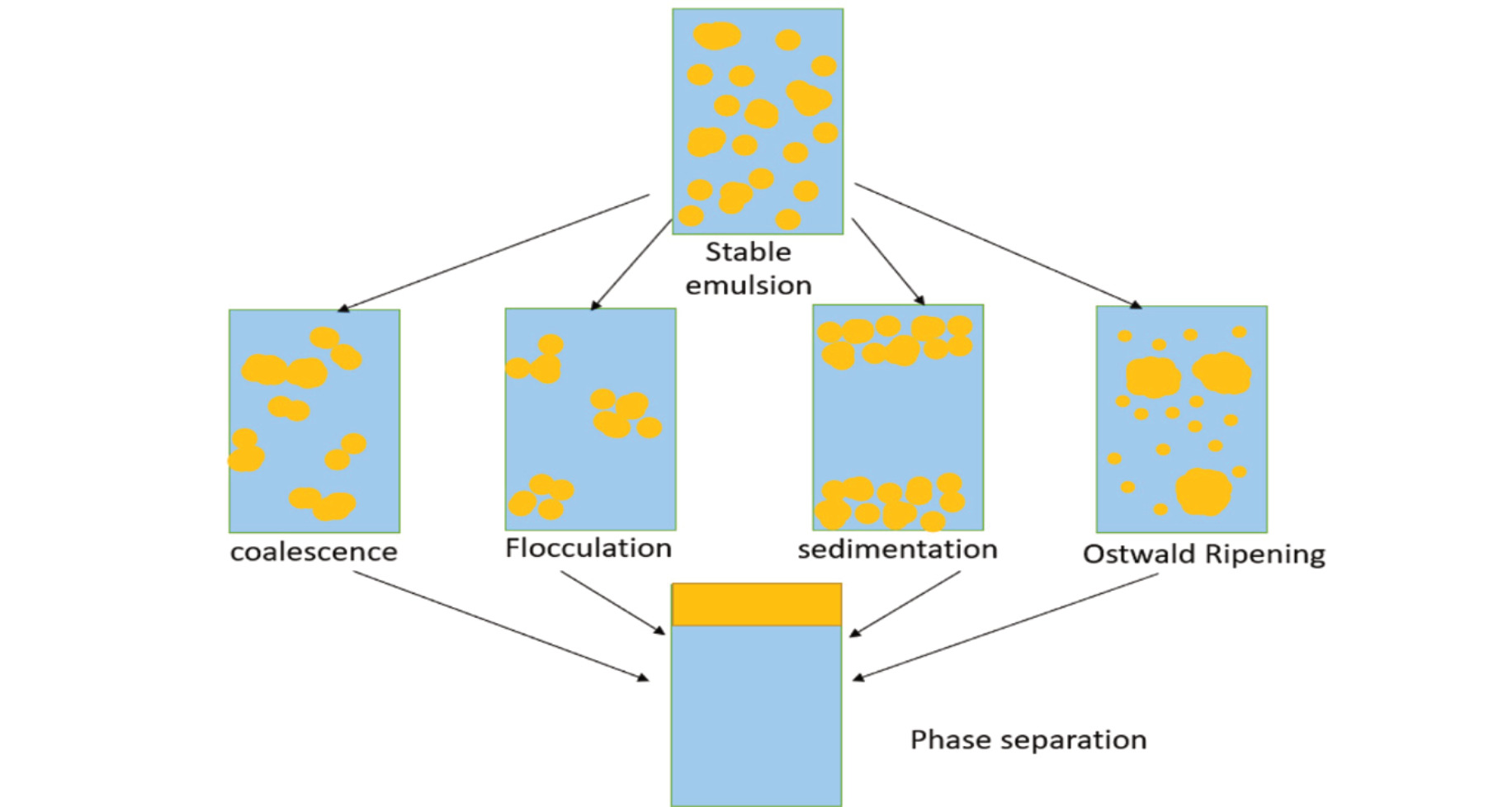
Figure 1: Emulsion destabilization mechanisms and pathways.